Marine Infrastructure — anonymized
Building an Always-On Project Intelligence System Across 36 U.S. Districts and Territories
A global superyacht infrastructure manufacturer replaced weekly outsourced lead monitoring with a system it controls: scheduled discovery, enrichment, relevancy scoring, human review, and CRM handoff.
Case study details
The Challenge
The client is a large-scale, global concrete floating dock manufacturer serving the superyacht market, delivering major marine infrastructure projects around the world. This build was created specifically to monitor public project activity across 36 U.S. districts and territories selected by its team.
Before BidSig, the company paid four people to monitor project sources every week. They found filings, collected the information, analyzed projects, and sent potential leads back. The company believed some relevant projects had been missed. It was also concerned that the same leads could be distributed to competitors.
The larger problem was control. The company could not easily change which areas were monitored, run a scan on demand, verify coverage, or see how opportunities were being evaluated.
Why This Was Possible
I was introduced through a friend who knew about my AI work. I had explored a similar concept before, and the combination of recent advances in AI and my experience designing agent workflows made it possible to turn that idea into a reliable operating system rather than a one-off script.
The Approach
BidSig handles the whole workflow, from discovery through sales handoff:
- scan selected public project sources
- extract and standardize project data
- check existing records and prevent duplicates
- add new opportunities to Airtable
- use Apify-powered web research to investigate the applicant, company, and project
- use JEV to classify the complete context and generate a relevancy score
- present the enriched opportunity for human review
- let a team member keep it under review, pass, or push it directly into HubSpot
The team can scan any area individually, combine areas into reusable custom groups, run a group on demand, or put it on a schedule. From one screen they can see scan timing, launch enrichment, review scores, open the source filing, and control the final sales decision.
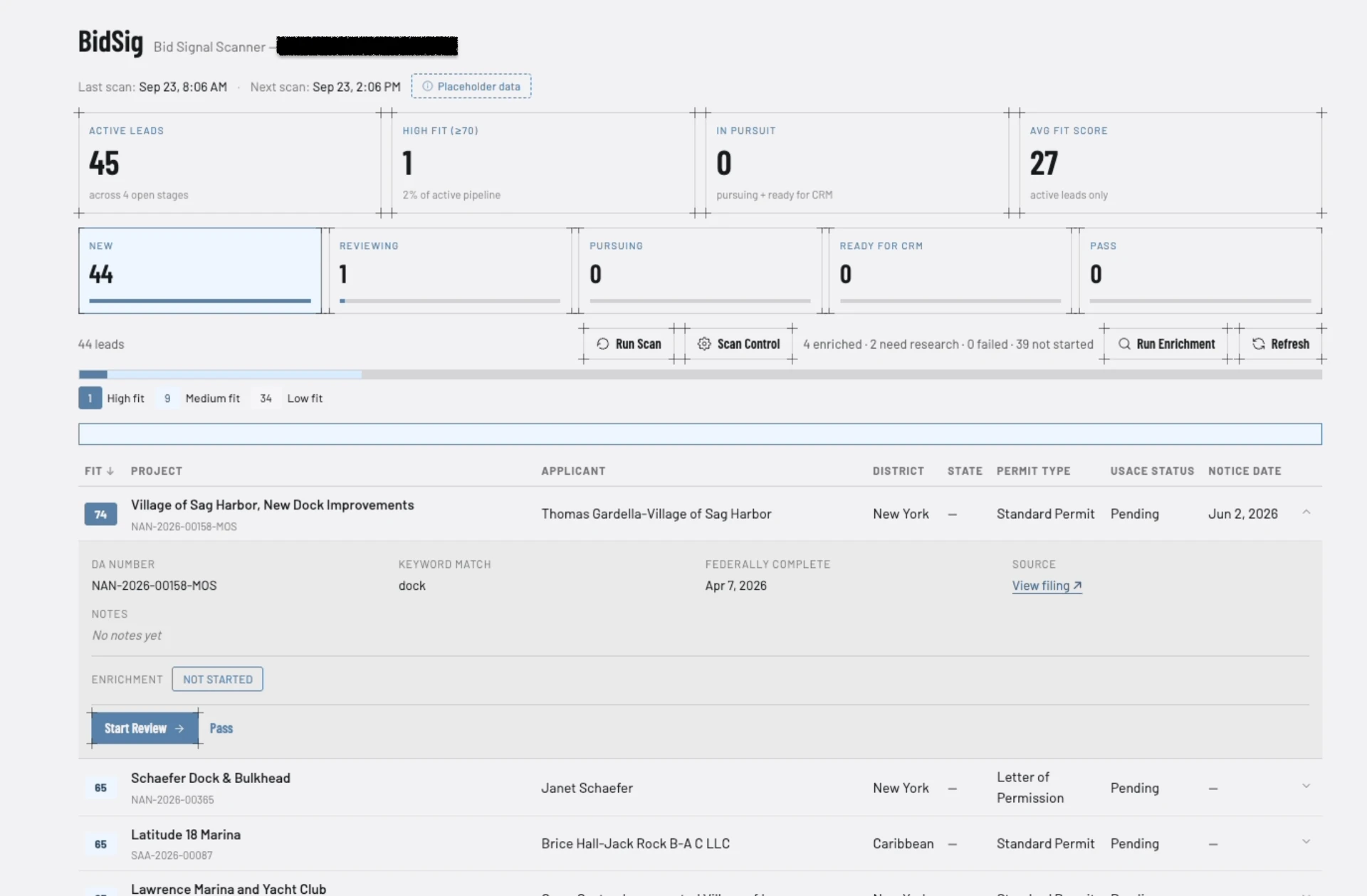
Baseline and Incremental Monitoring
The first scan of each area establishes the baseline by collecting relevant existing projects. Those initial baseline scans are complete across all 36 selected areas. From there, scans operate incrementally: only newly discovered projects are imported, while existing records are recognized and excluded.
Operational Performance
Observed initial-scan performance showed roughly 24 to 25 projects collected, formatted, enriched, classified, and scored in about five to six minutes. One district scan processed 27 projects in approximately six minutes; another processed 24 in approximately five minutes. These are representative observed runs, not the total number of scans and not a fixed runtime guarantee. Runtime depends on how many historical projects an area contains.
Ongoing scans are lighter, because the baselines are finished and only new projects need processing. Brief intentional pauses are built in to keep activity below source-site bot-detection and rate-limit thresholds.
The Results
- Baseline coverage completed across 36 selected U.S. districts and territories
- Continuous incremental monitoring of newly discovered projects
- Automatic duplicate prevention across every scan
- Consistent research and qualification on every opportunity
- Transparent JEV relevancy scoring the team can inspect
- Configurable individual, grouped, and scheduled scans
- Human oversight of every decision
- Direct handoff into HubSpot
- Ownership of a process previously outsourced to four people
The Takeaway
The key outcome is not merely speed. The company now owns how opportunities are discovered, evaluated, and routed to sales. The team can spend less time wondering whether a project was overlooked and more time choosing which opportunities deserve pursuit.
Yours would be the next one.
Send your details and I'll get back to you.